AI is ‘Magic’
systems-thinking and speculative fiction workshop on alternative AI ethics
“Any sufficiently advanced technology is indistinguishable from magic.”
– Arthur C. Clarke, Profiles of the Future: An Enquiry into the Limits of the Possible
“Pieces of fiction are simulations of selves in the social world. Fiction is the earliest kind of simulation, one that runs not on computers but on minds…”
– Keith Oatley, “Enchanted Determinism: Power without Responsibility in Artificial Intelligence”
The narrative that AI is akin to magic is found almost everywhere. From the AI products that have co-opted the ”sparkle” emoji (✨) to interfaces that mimic sleight of hand, the technology is surrounded and bolstered by mythologized stories of magic and incomprehensible power. This narrative is often seen as disarming and even worrisome by researchers and policy makers — something that could distract people from the important work of holding the organizations and people creating AI systems accountable. This is because these tales transform AI from a mere tool into something that is mystical and almost god-like, hindering our ability to comprehend the concrete ethics of how the technology is designed and governed, as if it were far beyond our control.
However, what would happen if we leaned into the narrative that AI is “like magic”? What could we learn? Fictions and fantasies, though “made up” figments of our imagination, capture deeply emotional and human realities that facts often cannot. They allow us to tap into how something feels and why it matters beyond just what it is, illuminating how we want to relate to power and each other. By embracing the discomfort that AI may be anything like magic, we can leverage the power of fiction to uncover a broader understanding of the systems we operate in and also probe alternatives by simulating different ideas for social, political, and ethical life. Flights of fancy become a mode of inquiry — not an escape from reality, but as a method for interrogating and imagining how our world might be otherwise.
In June, the Berkman Klein Center invited an interdisciplinary group of creatives and technologists to experiment with fiction in a speculative design and writing workshop. Facilitated by BKC research assistant Ami Mehta, the workshop asked participants to imagine and explore alternative worlds of AI ethics by using magic systems as an analogical lens. With tables covered with wands, swords, and witch hats, participants were able to immerse themselves in a range of established magical worlds from literature, and investigate how societies narrate and regulate powerful, poorly-understood forces.
Through systems-analysis of vastly different kinds of magic, from the allure of the One Ring in The Lord of the Rings to the tyranny of the Ministry of Magic in the Harry Potter series, participants grappled with difficult questions about governance, access, power, energy, class, risk, and accountability. Take Mistborn, Brandon Sanderson's rigidly class-stratified world where the ruling nobility controls not just access to magical ability, but the supply of the metals that fuel it. Or Christopher Paolini’s Eragon, where every spell that is cast directly squeezes the life and energy from the spellcaster’s own body or environment. Held next to AI, these fictional systems begin to shed light upon truths and complexities of our own world, crafting a provocative space for critical and generative discussion.
The workshop was structured in four stages to scaffold the cognitive leap from exploring fantasy worlds to hypothesizing about technology. Divided into small groups that were each assigned a text, the workshop asked each team to first study their given magic system: who accesses it, who governs it, what it costs, what it corrupts, and what are its limits.
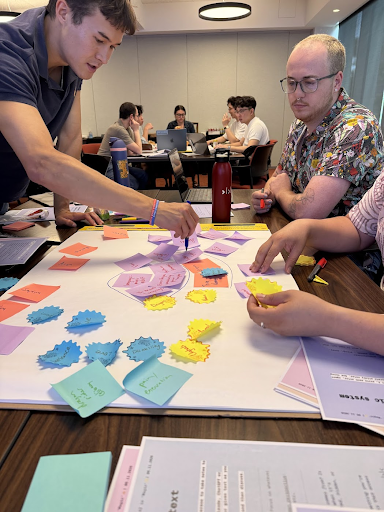
The second stage asked groups to list all the agents and actors of their magic system based on their earlier discussion. These are elements that can be identified on separate sticky notes such as individuals, institutions, creatures, things, rules, infrastructure and more. As participants amassed piles of sticky notes, patterns began to emerge, including connections and flows of energy or power. These were organically laid out on large sheets of blank chart paper building visualizations or maps of their systems with the sticky notes acting as nodes connected by hand-drawn lines that marked boundaries or dependencies.
 The third stage then asked participants to swap out magic in their systems-maps for AI. This meant replacing a handful of actors, flows, or rules in their maps with the technology(s), and observing what stories might be generated in doing so. As they made their swap, participants were told the following: “you are travelling from the world you explored to one that is entirely new. Let your new world take root, carrying forward ideas and relationships that provoke you, letting go of details that are no longer relevant.”

The workshop’s final stage built on this fertile foundation with a ruminative, creative act. Participants selected a single strand of thought that interested them the most and individually wrote pieces of flash fiction in 200 words, materializing just a glimpse of a speculative world. This required embodying the systems they had been exploring up to that point — with characters, emotions, and senses — painting worlds of conflict and resolution.
 The stories participants wrote were highly nuanced. They shifted attention away from familiar concerns about AI accuracy or bias, and toward questions of governance, literacy, sacrifice, inheritance, and collective power. Instead of rehashing the typical spectacle of fear currently dominating public discourse, the writing surfaced those quieter, underlying structural harms that govern our relationship with AI. Many stories centered on day-to-day life and the agency that ordinary people have within systems. They depict power — and its refusal — as diffuse, infrastructural, and cultural rather than singular and absolute, operating through everyday routines, habits, and institutions. And then they invite us, if only for a moment, to consider what kinds of societies we want to cultivate, and what futures we ultimately wish to build.
Please explore some of these worlds that have been kindly shared below for our readers!
~~~
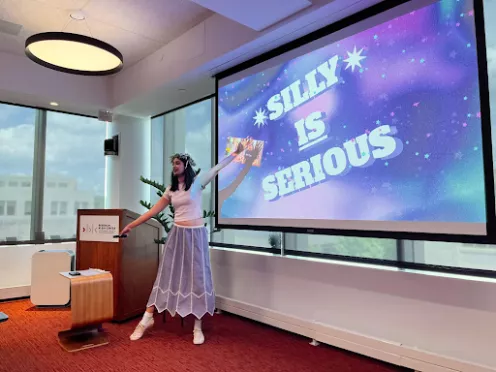
This workshop was designed by BKC RA Ami Mehta as a way of bringing together her interests in fiction, dreaming methodologies, and AI research. An experienced facilitator, she begins each of her workshops with a simple mantra: Silly is Serious: being playful can surface deeper reflection about ethics and values and that embracing absurdity can be strikingly generative. Her work develops methods of collective dreaming and imagination for various organizations, including universities, local government and the UN.
Bibliography
Clarke, Arthur C. Profiles of the Future: An Enquiry into the Limits of the Possible. Revised edition. Harper & Row, 1973.
Campolo, Alexander, and Kate Crawford. "Enchanted Determinism: Power without Responsibility in Artificial Intelligence." Engaging Science, Technology, and Society 6 (2020): 1–19. https://doi.org/10.17351/ests2020.277.